SBIR vs STTR for Defense Technology Companies
SBIR and STTR differ in research workshare, investigator employment, and partner rights. Match the team to the opportunity and plan for the defense customer beyond R&D.
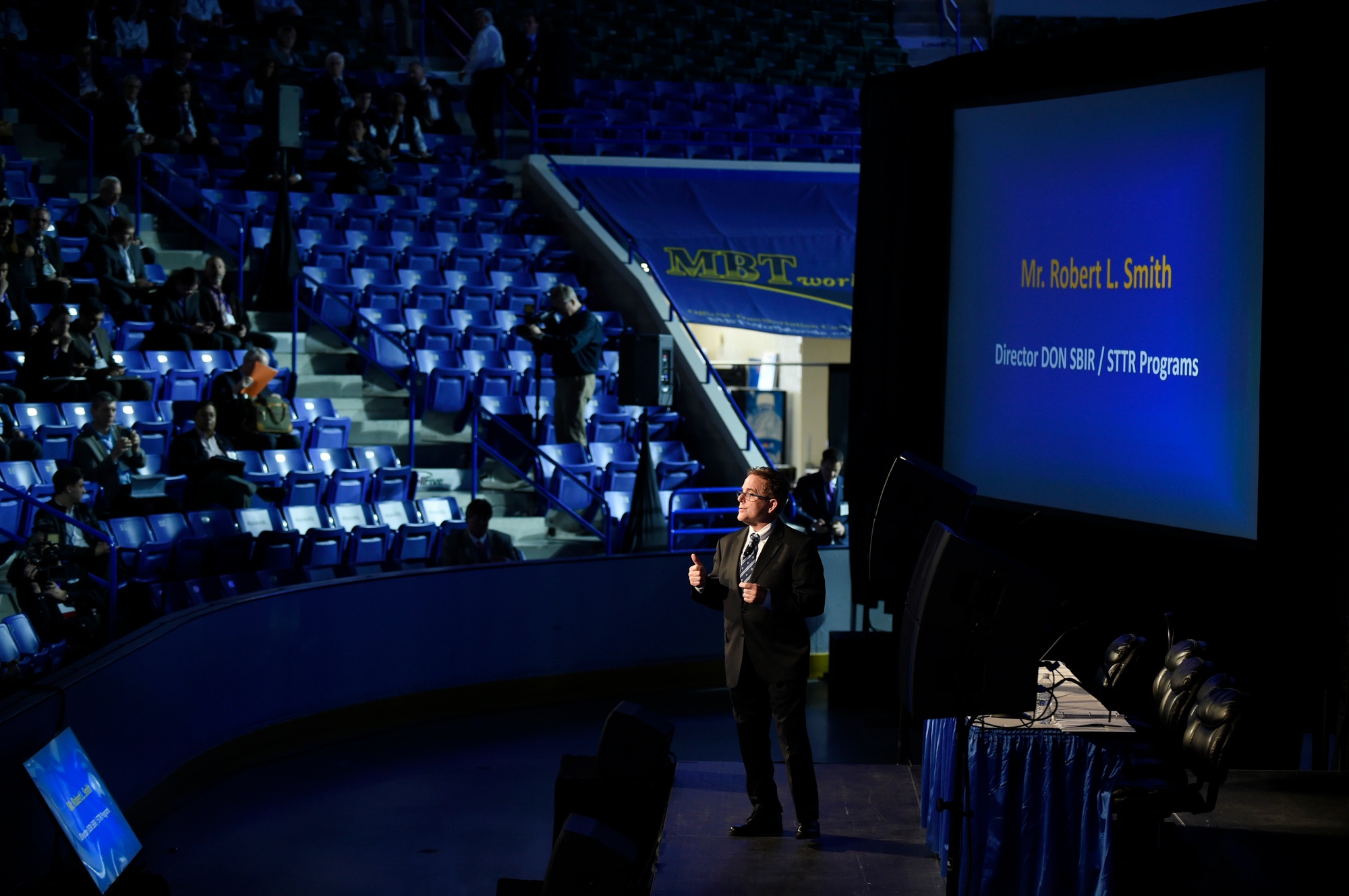
Small Business Innovation Research (SBIR) and Small Business Technology Transfer (STTR) are funding programs, rather than promises of a production order. A university-originated invention can fit either, depending on the proposed work. STTR also accommodates company-originated technology that needs a research institution's capabilities.
On This Page
- The differences that change your operating plan
- Eligibility comes before proposal spending
- Build the workshare before choosing the program
- Separate partner IP from government data rights
- Plan for the customer beyond research funding
- Make the bid decision against a specific topic
The differences that change your operating plan
The main rules below apply to the ordinary Phase I and Phase II structure. Read the current solicitation and component instructions for permitted exceptions, calculations, and personnel commitments.
| Decision | SBIR | STTR | Business consequence |
|---|---|---|---|
| Award recipient | Eligible small business | Eligible small business | The company remains responsible for execution; the university does not apply as prime. |
| Research partner | Optional | Qualifying U.S. research institution required | STTR needs an institutional commitment, not simply a professor advising independently. |
| Company research share | At least two-thirds in Phase I; at least one-half in Phase II | At least 40% in both phases | Staff and subcontract plans must support the required share. |
| Research-institution share | No mandatory minimum | A single partnering institution performs at least 30% | STTR reserves a substantial research role for the partner. |
| Principal investigator | Primary employment generally with the company | May be primarily employed by the company or research institution | A faculty-led team has different staffing options. |
| Partner IP agreement | Negotiate rights needed for any subcontract or licensed technology | Formal allocation of IP and follow-on rights required | Settle commercialization access before depending on the partner's research. |
Source basis: defense program guidance, DARPA's comparison, and SBA's general FAQ, checked September 8, 2026. The business consequences are editorial interpretation of those requirements. The defense overview labels its summary funding figures FY25; those amounts are not a current solicitation budget.
The investigator's employment requirement is separate from the company's research percentage. One concerns the person's employer; the other concerns allocation of the project. The defense eligibility guidance defines primary employment as more than half of the investigator's time with the business. Check the actual personnel requirements before promising that someone with a full-time outside position will lead an SBIR effort.
Eligibility comes before proposal spending
The applicant must qualify as a for-profit small business under the programs' ownership, control, and size rules. The ordinary ownership route requires more than 50% ownership and control by U.S. citizens or permanent residents, or qualifying small businesses. The size limit includes affiliates and is no more than 500 employees. Research normally must be performed in the United States. A qualifying STTR research partner may be a U.S. nonprofit college or university, nonprofit research organization, or federally funded research and development center. SBA's eligibility FAQ identifies the requirements and the company's certification responsibility.
For investors, ownership deserves a separate check. Minority institutional investment is not automatically disqualifying, but control and affiliation matter. Some agencies elect to accept certain companies majority-owned by multiple venture-capital operating companies, hedge funds, or private-equity firms under an SBIR-specific authority. Do not assume that route also makes a company eligible for STTR. Review the actual ownership and governance arrangement against SBA's venture-capital guidance before relying on an award in a financing plan.
The programs are currently authorized through September 30, 2031 under Public Law 119-83, approved April 13, 2026. The law also strengthens security review and requires agency proposal limits beginning in fiscal year 2027. Authorization does not establish an open topic, an award, or a cash receipt. The enacted law, particularly sections 2, 4, and 9, supplies that current context.
Build the workshare before choosing the program
Draft a task allocation with the technical lead and proposed partner before writing the narrative. Identify who performs each experiment, develops the software, runs the facility, and integrates the result. Then cost that work using the solicitation's prescribed calculation. A percentage of research effort should not be casually treated as the same percentage of every dollar in the total award.
Consider three hypothetical Phase I teams. The shares below represent research effort on a consistent basis, not proposed award prices or a substitute for agency costing instructions.
| Illustrative research allocation | Initial program fit | What the founder must resolve |
|---|---|---|
| Company 75%; university 25% | SBIR workshare fits; STTR's institution minimum is unmet | Does limited university testing provide everything needed for the company's development plan? |
| Company 50%; university 50% | STTR workshare fits; ordinary SBIR Phase I company minimum is unmet | Can the institution commit the people, facilities, and IP rights needed for delivery? |
| Company 40%; university 30%; other subcontractor 30% | STTR's two minima are met | Can the company manage integration and retain enough capability to support the customer afterward? |
These are editorial scenarios applying DARPA's published workshare rules, not eligibility determinations. Meeting the percentages alone does not establish that the team meets ownership, investigator, or solicitation requirements.
SBIR is a sensible starting point when the company can lead and perform the required research itself, using a partner for a bounded task. STTR fits when the institution contributes essential research at the required scale. Hiring an academic as an individual consultant does not, by itself, create the institutional partnership STTR requires. SBA's tutorial makes that distinction explicit.
Avoid redesigning the work solely to make a percentage pass. Ask whether the resulting team can solve the technical problem and leave the company able to manufacture, integrate, or support the eventual product.
Separate partner IP from government data rights
STTR requires the company and institution to agree on allocation of intellectual-property rights and rights for follow-on research, development, or commercialization. The requirement described in SBA's FAQ does not mean the company automatically owns everything the institution develops.
A useful negotiation agenda distinguishes preexisting inventions and software from project-generated results. Establish which licenses the company needs, what it can sublicense to a customer or prime contractor, and what happens if the relationship ends. Address publication review, invention reporting, and responsibility for obtaining permissions. Resolve these questions while defining the partner's work, so the technical plan and commercialization rights fit together.
The government's license is another matter. The August 2025 version of DFARS 252.227-7018 provides a 20-year SBIR/STTR data-protection period beginning with the award under which the data are developed or generated, unless a different period is negotiated after award. Its protections have exceptions, including categories in which the government receives unlimited rights, and require appropriate markings and supporting records.
Treat that period as a contract-data rule. It does not establish ownership of a university patent or clear rights to third-party software. Trace older data to the clause under which they were generated. Redelivering identical data covered by the 20-year rule does not restart that period; earlier clause versions can work differently. DFARS Procedures, Guidance, and Information Part 227 gives examples involving earlier clauses and later deliveries.
Plan for the customer beyond research funding
Phase I addresses feasibility. Phase II develops the research further. Phase III covers work derived from, extending, or completing prior SBIR/STTR effort using funding outside the SBIR/STTR programs. That can include other federal funding as well as private commercialization. It is not an automatically funded third installment. SBA's Policy Directive, section 4, explains the phases.
For qualifying federal Phase III work, prior SBIR/STTR competition can satisfy competition requirements; a new competition is not necessarily required. The directive provides a preference for the originating awardee, subject to the stated conditions. That is a valuable acquisition path, but a technical award alone does not prove that an acquisition office has a requirement or money ready to spend.
Build the transition discussion around a named user, the organization that can buy, an integration need, and the evidence needed to support that purchase. A research sponsor and the eventual buyer may have different acceptance questions. In a hypothetical sensor project, demonstrating measurement feasibility leaves separate questions about integration, repeatable production, and support. Put those questions into the development plan early.
The 2026 law also expands direct-to-Phase-II authority to STTR for specified agencies, including defense. Older blanket statements that STTR always requires a prior Phase I are therefore incomplete. Section 10 of Public Law 119-83 establishes the change; a company still needs a solicitation that actually offers the route and must meet its requirements.
Make the bid decision against a specific topic
Start with an actual defense topic and its current instructions. The funding mechanism may be a Broad Agency Announcement (BAA) or, in some cases, a Commercial Solutions Opening (CSO). The official funding-opportunities page directs applicants to the Defense SBIR/STTR Innovation Portal and explains the question process. Direct discussion with topic authors is restricted once the opportunity opens; use the permitted topic Q&A process and dates.
Before committing proposal effort, put five items on one page: program and phase offered, eligible applicant and investigator, costed research allocation, required partner rights, and a plausible follow-on customer. Add the topic's award ceiling, duration, deliverables, and payment terms from its instructions instead of importing figures from another component's overview.
Choose SBIR when the company can carry the research and the institution is optional or narrowly supporting. Choose STTR when a qualifying institution is central to the work and both parties can commit to the research and commercialization arrangement. If neither team structure can deliver the project within the opportunity's rules, resolve that mismatch before bidding.
Source notes
- SBA, SBIR or STTR?: official tutorial on partner roles and program selection.
- Defense SBIR/STTR program guidance: workshare and investigator employment; summary funding figures are labeled FY25.
- DARPA, SBIR and STTR overview: component explanation of team requirements and phases.
- SBA, general FAQ: STTR research allocation and partner IP agreement.
- SBA, eligibility FAQ: applicant size, qualification, and research institutions.
- SBA, venture-capital FAQ: ownership, affiliation, and SBIR-specific investment provisions.
- Public Law 119-83: enacted 2026 authorization, security review, proposal limits, and phase flexibility.
- DFARS 252.227-7018: August 2025 contract clause on technical data, software, and markings.
- DFARS PGI Part 227: official examples of protection periods across successive contracts.
- SBA, SBIR/STTR Policy Directive: phase structure and Phase III acquisition treatment; later enacted law controls superseded dates and authorities.
- Defense funding opportunities: BAA/CSO mechanisms, proposal portal, and topic-question procedures.
Last checked: September 8, 2026.
Documentation
Sources
These are the recoverable records used for this analysis. Dates describe the source record; access dates describe our verification pass.
- SBIR or STTR? Which one is right for me?U.S. Small Business Administration · Publication date not recorded · checked September 8, 2026
- Defense SBIR/STTR program guidanceOffice for Small Business Innovation · Publication date not recorded · checked September 8, 2026
- SBIR and STTR programs overviewDARPA · Publication date not recorded · checked September 8, 2026
- SBIR/STTR general questionsU.S. Small Business Administration · Publication date not recorded · checked September 8, 2026
- SBIR/STTR eligibility requirementsU.S. Small Business Administration · Publication date not recorded · checked September 8, 2026
- SBIR/STTR venture-capital participationU.S. Small Business Administration · Publication date not recorded · checked September 8, 2026
- Public Law 119-83: Small Business Innovation and Economic Security ActU.S. Government Publishing Office · April 13, 2026 · checked September 8, 2026
- DFARS 252.227-7018, August 2025Acquisition.gov · Publication date not recorded · checked September 8, 2026
- DFARS PGI Part 227: Technical Data and Associated RightsAcquisition.gov · Publication date not recorded · checked September 8, 2026
- SBIR/STTR Policy DirectiveU.S. Small Business Administration · Publication date not recorded · checked September 8, 2026
- Defense SBIR/STTR funding opportunitiesOffice for Small Business Innovation · Publication date not recorded · checked September 8, 2026